

A network security assessment has become a standard part of enterprise security programs as organizations manage increasingly distributed network environments. The combination of on-premises infrastructure, cloud services, third-party connectivity and remote access has introduced greater operational complexity, making it difficult to maintain a consistent view of network security across the enterprise.
Assessing a network's condition requires a structured approach to what to test, how to test it and how to interpret the results. This article explores the fundamentals of network security assessment, the assessment process, common methodologies and how to choose the service provider.
What is a Network Security Assessment
A network security assessment is a systematic process of evaluating an organization's network environment to identify vulnerabilities, configuration weaknesses and security gaps that could expose systems, applications, or data to cyber threats.
Unlike isolated security tests that focus on a single aspect of the environment, a network security assessment provides a broader view of the network's overall security. It identifies areas that require further investigation and establishes a baseline for measuring the effectiveness of existing security measures. The findings help organizations understand where risks exist before they determine the appropriate remediation strategy.
What Does a Network Security Assessment Evaluate
The scope of a network security assessment extends across the entire network environment. It examines the key areas that influence how users, devices, applications and data interact across the network.
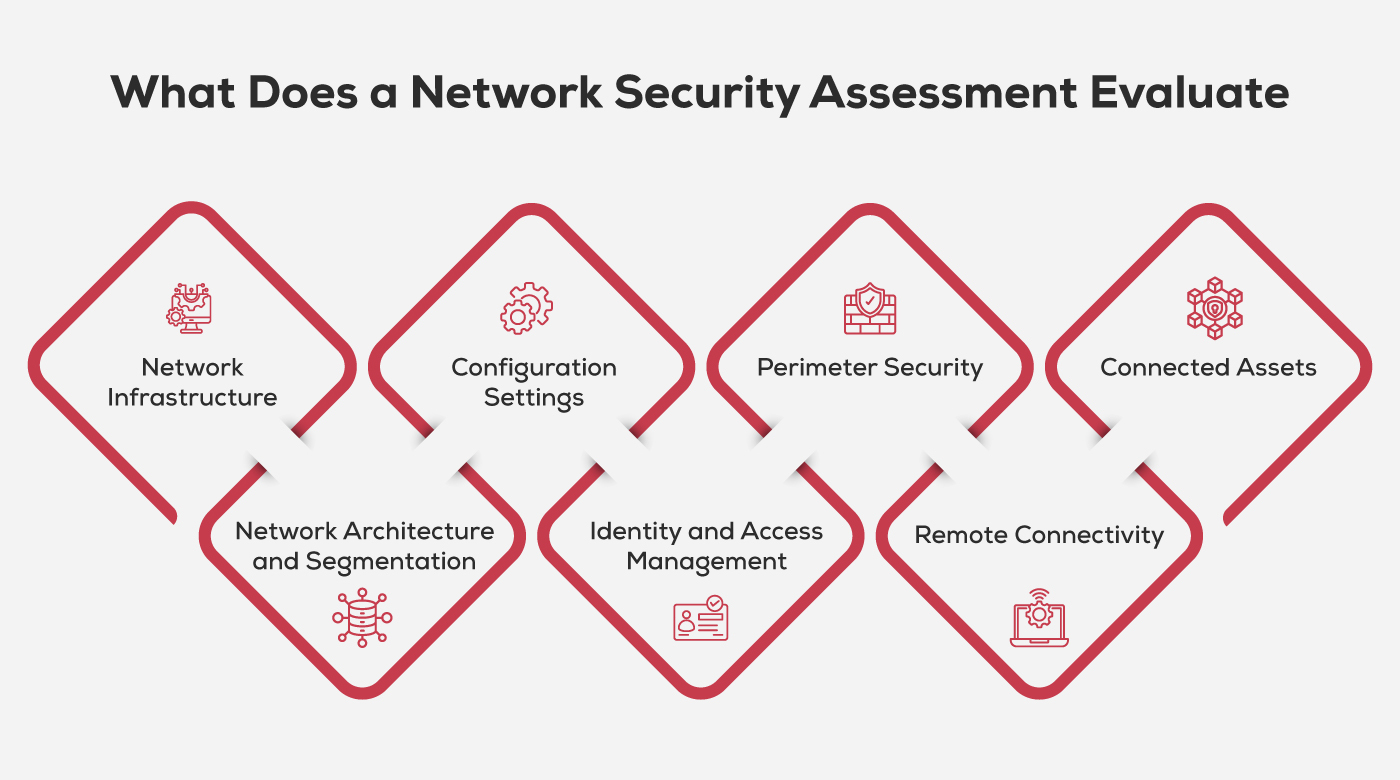
Network Infrastructure
This includes physical and virtual network assets such as routers, switches, servers, gateways, endpoints and cloud-connected resources. The assessment establishes an inventory of these assets and examines their role within the overall network environment.
Network Architecture and Segmentation
The logical structure of the network is reviewed to understand how different environments communicate with one another. The assessment also examines segmentation boundaries between users, workloads, applications and critical systems to identify unnecessary communication paths.
Configuration Settings
Configuration parameters across network devices and supporting services are reviewed for inconsistencies, deprecated settings, unsupported protocols and deviations from internal standards.
Identity and Access Management
Identity and Access Management evaluates authentication mechanisms, privilege allocation, administrative accounts, and network access policies to determine how access is granted, restricted and managed across the environment.
Perimeter Security
Security mechanisms that regulate inbound and outbound network traffic, including firewall policies and gateway configurations, are examined to understand how external and internal communications are controlled.
Remote Connectivity
Remote access technologies, VPN connections and wireless networks are evaluated to understand how users connect to enterprise resources from outside the corporate network.
Connected Assets
The assessment extends to network-connected devices beyond traditional IT infrastructure, including printers, IP phones, IoT devices and Operational Technology (OT) systems, where applicable.

Types of Network Security Assessments
Organizations use different types of network security assessments depending on the objective of the engagement. While each assessment focuses on a specific aspect of network security, they are often performed together to provide a more complete view of the environment.
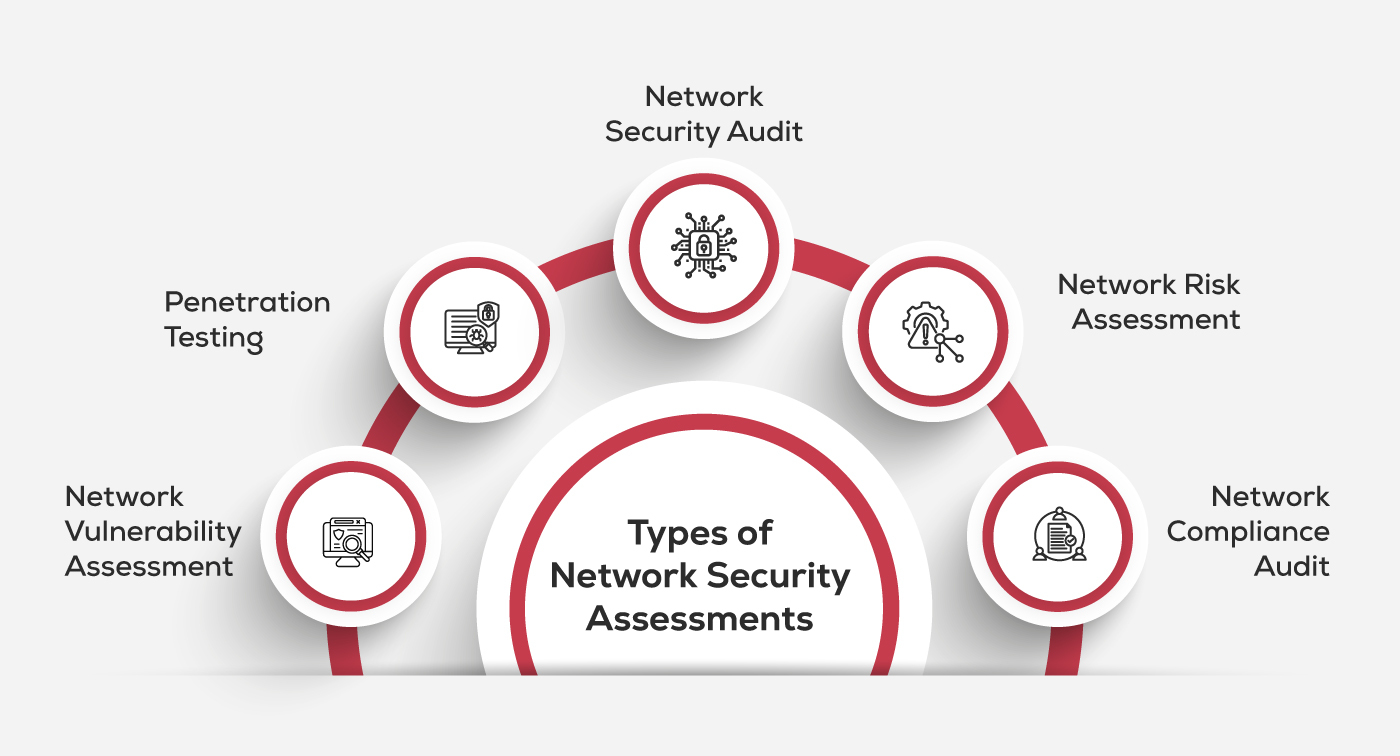
Network Vulnerability Assessment
A network vulnerability assessment focuses on discovering known security weaknesses across network assets. It relies on vulnerability scanning and validation techniques to detect software flaws, missing patches, outdated services and publicly known vulnerabilities. The results are categorized according to severity to support remediation planning.
Penetration Testing
Penetration testing simulates the tactics of an attacker to determine whether identified weaknesses can be exploited. Unlike a vulnerability assessment, it validates the practicality of an attack by attempting to gain unauthorized access, escalate privileges or move laterally within the network under controlled conditions.
Network Security Audit
A security audit network engagement verifies whether network governance, documented procedures, and implemented safeguards align with established organizational standards. It focuses on consistency, accountability, and adherence to defined security requirements rather than identifying technical vulnerabilities.
Network Risk Assessment
A network risk assessment analyzes the potential business impact of identified issues by considering factors such as asset criticality, likelihood of exploitation and operational consequences. This enables organizations to prioritize remediation efforts based on business risk rather than technical severity alone.
Network Compliance Audit
A network compliance audit determines whether the network environment satisfies applicable regulatory compliance, contractual and industry-specific requirements. Depending on the organization's obligations, the review may include standards such as ISO/IEC 27001, PCI DSS, HIPAA, or other applicable regulations to demonstrate security compliance.
How to Conduct a Network Security Assessment
A structured methodology ensures that the assessment is performed consistently and produces reliable results. Although the scope may differ across organizations, the security assessment steps generally follow a defined sequence from planning through reporting.
- Define the Assessment Scope
Every assessment begins by establishing its objectives, engagement boundaries, timelines, stakeholders and success criteria. This planning stage determines the extent of the assessment and provides a clear framework for all subsequent activities.
- Validate the Assessment Scope
Before technical validation begins, the assessment team confirms that the documented inventory, network diagrams and supporting documentation accurately reflect the current environment. This verification forms the basis of the network audit process and minimizes the possibility of incomplete coverage.
- Perform Technical Validation
The assessment is carried out using appropriate security evaluation methods selected for the engagement. These methods are applied to collect technical evidence, validate observations and examine the network from multiple perspectives. Depending on the scope, this phase may also include attack surface analysis to identify externally exposed assets and potential entry points.
- Correlate and Analyze Findings
Individual observations rarely present the complete picture. Findings are correlated to understand how they relate to one another, allowing the assessment team to perform network threat analysis and distinguish isolated issues from patterns that could increase overall exposure.
- Prioritize Assessment Findings
Once the analysis is complete, observations are classified according to predefined risk criteria. This security risk analysis helps establish remediation priorities by considering business impact, exploitability and the significance of the affected assets.
- Prepare the Assessment Report
The final report consolidates validated observations, supporting evidence, risk classifications and recommended corrective actions into a structured document. It also provides the foundation for security gap analysis, enabling organizations to plan remediation activities and measure progress during future assessments.

Benefits of a Network Security Assessment
A well-executed network security assessment provides valuable insights that support both security and business objectives. The following are its key benefits.
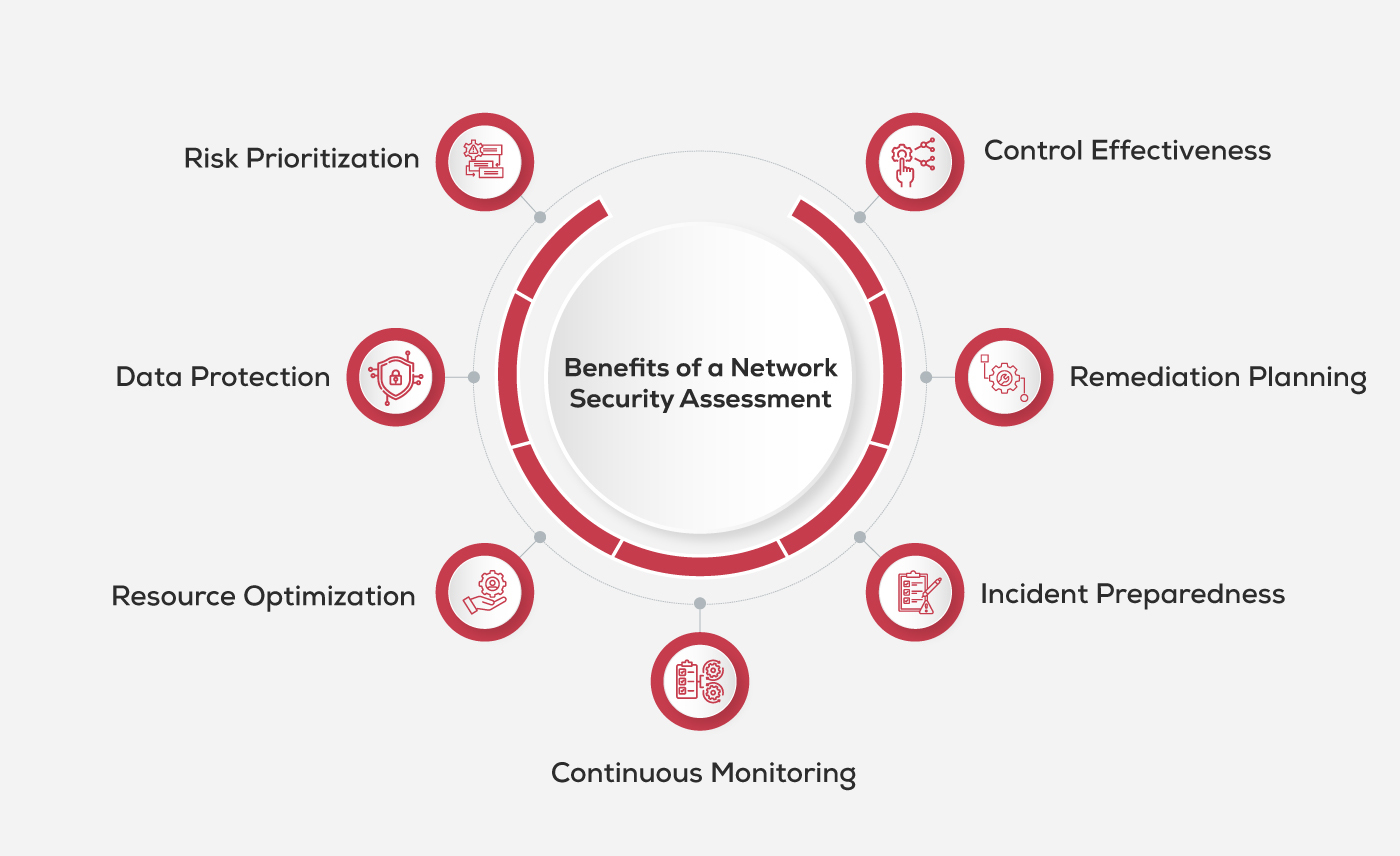
- Risk Prioritization
Instead of treating every finding with equal importance, the assessment helps organizations rank issues according to business impact and likelihood of exploitation. This enables more effective cyber risk management by directing resources toward the areas that present the greatest operational risk.
- Data Protection
The assessment highlights weaknesses that could expose sensitive business information during storage, transmission or access. Addressing these findings contributes to stronger data protection across the network environment.
- Resource Optimization
Assessment reports provide evidence-based priorities, allowing organizations to allocate budgets, technical resources and remediation efforts where they will have the greatest impact instead of addressing issues in isolation.
- Continuous Monitoring
Assessment results establish a measurable reference point that helps organizations validate future changes and identify deviations over time. This strengthens security monitoring by providing context for evaluating the effectiveness of ongoing security operations.
- Incident Preparedness
Understanding the location and severity of security gaps enables response teams to make faster, better-informed decisions during a security event. The assessment also helps refine incident response plans by highlighting assets and network segments that require greater attention.
- Remediation Planning
Assessment findings provide a structured basis for planning corrective actions. This allows organizations to sequence remediation activities according to business priorities and develop a practical risk mitigation roadmap rather than relying on ad hoc fixes.
- Control Effectiveness
A network security assessment also evaluates whether implemented security controls continue to perform as intended. This helps organizations identify controls that require refinement, replacement, or additional coverage as the network evolves.
When Should You Conduct a Network Security Assessment
The timing of a network security assessment depends on changes to the network environment, business operations and regulatory obligations. The following scenarios typically warrant a new assessment.
- Before Deploying New Infrastructure
Conduct an assessment before introducing new network infrastructure, cloud environments or business-critical applications to identify implementation issues before the environment enters production.
- After Significant Network Changes
Network expansions, architecture modifications and major configuration changes can alter communication paths and access patterns. An assessment verifies that these changes have not introduced unintended exposure.
- Following a Security Incident
Following a security incident, an assessment helps validate that corrective actions have been implemented and identifies any remaining areas requiring further investigation.
- After Mergers, Acquisitions, or IT Integration
Integrating networks from different organizations often introduces inconsistent configurations, overlapping technologies, and inherited security issues. An assessment provides visibility into the combined environment before full integration.
- As Part of a Periodic Security Program
Many organizations establish recurring assessment cycles to verify that changes introduced since the previous assessment have been independently validated.
How to Choose a Network Security Assessment Provider
The effectiveness of a network security assessment depends not only on the methodology used but also on the expertise and capabilities of the assessment provider. Evaluate a provider against a well-defined criteria listed below:
- Technical Expertise
Choose a provider with experience in assessing diverse network environments, including on-premises infrastructure, cloud deployments, hybrid networks and remote access architectures. The team should be capable of assessing complex enterprise environments rather than relying solely on automated tools.
- Assessment Methodology
Review the provider's assessment approach to understand how engagements are planned, executed, validated and documented. A well-defined methodology should produce consistent findings, supported by technical evidence and clear documentation.
- Industry Experience
Industry-specific experience enables the provider to understand sector-specific network architectures, operational challenges and regulatory expectations. This helps ensure the assessment reflects the organization's business context rather than a generic evaluation approach.
- Reporting Quality
Assessment reports should clearly describe identified observations, supporting evidence, risk classifications, and recommended actions. Well-structured reporting enables technical teams and business stakeholders to interpret the results and establish remediation priorities.
- Post-Assessment Support
The provider should offer guidance during remediation by clarifying assessment findings, validating corrective actions and addressing technical queries that arise after the assessment is completed.
How Inspirisys Can Help
A thorough network security assessment requires technical expertise, proven assessment methodologies and practical remediation guidance. Inspirisys provides Vulnerability Assessment and Penetration Testing (VAPT) services that help organizations identify and validate security weaknesses across their IT environment, with a strong focus on evaluating network infrastructure and strengthening enterprise network security.
Our security specialists combine automated assessment techniques with expert-led validation to deliver risk-rated reports and actionable recommendations tailored to your environment. From assessing existing network infrastructure to validating security after major infrastructure changes, Inspirisys helps organizations make informed decisions to strengthen their network security posture.
Frequently Asked Questions
1. Can small businesses perform network security assessments on their own?
Small businesses can perform basic assessments using automated tools, but these often provide limited visibility into complex security issues. A professional assessment combines technical expertise, manual validation, and risk analysis to deliver more accurate and actionable results.
2. What is the difference between a network security assessment and vulnerability scanning?
A vulnerability scan identifies known security weaknesses using automated tools. A network security assessment is broader in scope, combining scanning with configuration reviews, manual analysis, and risk evaluation to provide a comprehensive understanding of the network's security.
3. What is segmentation testing?
Segmentation testing verifies whether network segments are properly isolated and whether access restrictions between them function as intended. It helps confirm that sensitive systems remain protected and that unauthorized movement across the network is restricted.
4. What are the four pillars of network security?
The four pillars of network security are Prevention, Protection, Detection, and Response. Together, they help organizations reduce the likelihood of cyberattacks, safeguard critical assets, identify suspicious activity, and respond effectively to security incidents, forming a continuous approach to securing enterprise networks.