For many organizations, data center modernization has become a business necessity as legacy infrastructure struggles to keep pace with growing workloads, evolving cybersecurity risks and changing operational demands. To remain competitive, organizations require a well-defined IT modernization strategy that ties technology decisions to long-term business success.
Modernizing data center infrastructure creates a foundation that can adapt to future demands while supporting greater flexibility and operational resilience. In this article, we explore the key benefits of data center modernization, its essential components and the considerations for building a scalable IT environment.
What is Data Center Modernization
Data center modernization is the process of upgrading, optimizing and transforming existing IT infrastructure to meet the performance and operational requirements of modern businesses. Unlike a conventional data center upgrade, which typically focuses on replacing aging hardware or expanding capacity, modernization takes a holistic approach by rethinking how data center infrastructure is designed, managed and operated.
As part of a broader IT infrastructure upgrade, organizations adopt more agile architectures and intelligent management capabilities that enable their IT environments to remain adaptable as business and technology requirements change.
Why is Data Center Modernization Important
Many enterprise data centers were designed for predictable workloads and centralized IT environments. Today, organizations operate in a vastly different landscape shaped by cloud adoption, AI-driven applications, distributed workforces and rapidly growing data volumes. These demands have outgrown the capabilities of traditional infrastructure, prompting organizations to rethink their data center strategy.
Without a structured IT modernization strategy, organizations may find it increasingly difficult to support new technologies, complete a legacy system upgrade, or execute a seamless data center migration. Modern data center addresses these evolving demands by creating an infrastructure that is better equipped to support current and future business requirements.
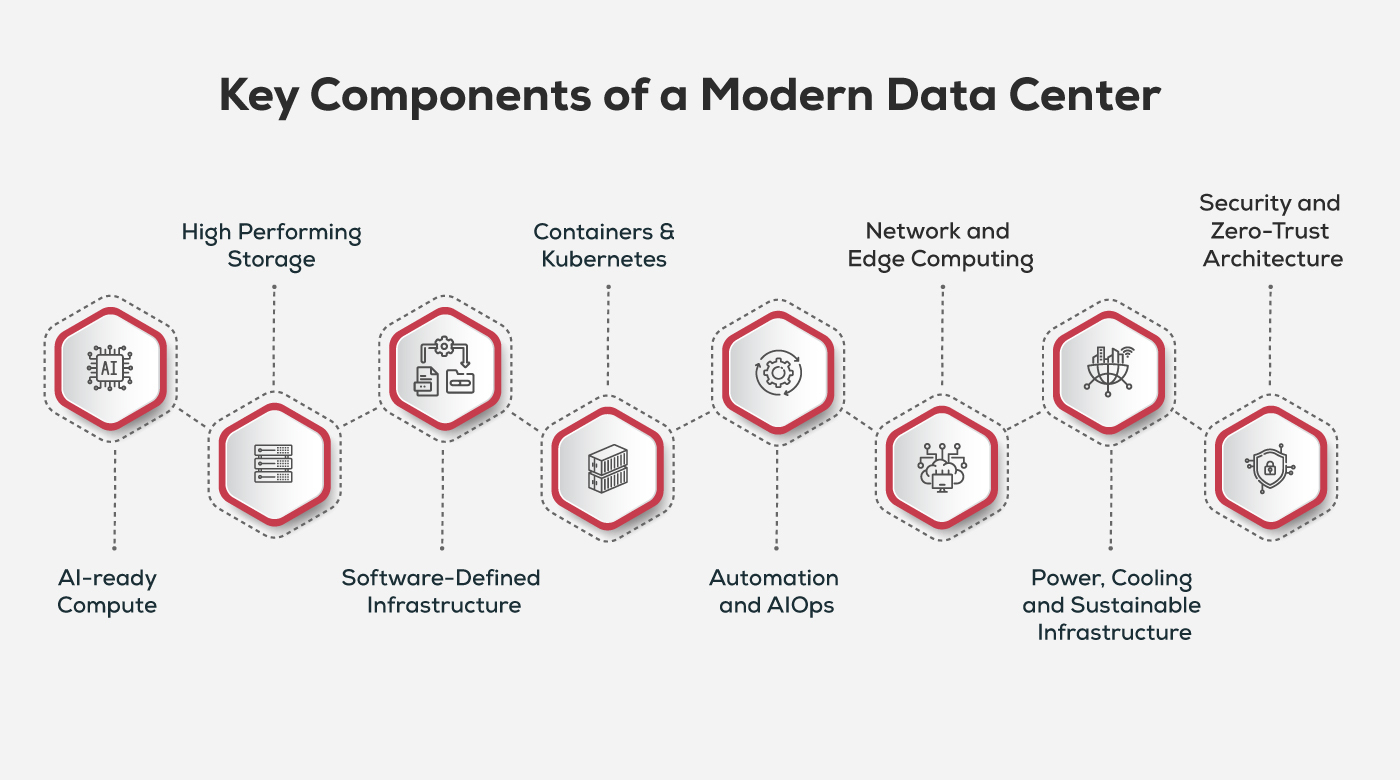
Key Components of a Modern Data Center
Data center modernization is built on a combination of technologies that work together to modernize infrastructure and operations. The following components form the core of a modern data center.
1. AI-ready Compute
As organizations adopt Artificial Intelligence (AI), Machine Learning (ML), High-Performance Computing (HPC), and data-intensive applications, traditional CPU-centric servers often struggle to meet growing processing demands.
Modern compute infrastructure incorporates high-performance processors, GPU-accelerated servers, and AI-ready hardware capable of handling complex workloads efficiently. Upgrading compute resources significantly improves data center performance, enables faster application processing and provides the flexibility required for future business growth.
2. High Performing Storage
Modern applications generate enormous volumes of structured and unstructured data that require fast and reliable storage solutions. Traditional storage architectures can become performance bottlenecks as data volumes continue to grow.
Organizations are increasingly adopting Non-Volatile Memory Express (NVMe) Solid-State Drives (SSDs), all-flash storage arrays, Software-Defined Storage (SDS), and object storage to store, access and manage data more efficiently. These technologies help improve application responsiveness while making it easier to integrate cloud environments and support data center migration.
3. Software-Defined Infrastructure
One of the defining characteristics of IT infrastructure modernization is the shift from hardware-dependent management to software-defined infrastructure. Technologies such as Software-Defined Networking (SDN), Software-Defined Data Centers (SDDC), server virtualization and Hyper-Converged Infrastructure (HCI) move compute, storage and networking resources from the underlying hardware.
This approach enables centralized management, simplifies resource provisioning, improves data center optimization and allows organizations to scale infrastructure more efficiently.
4. Containers & Kubernetes
Modern enterprises increasingly develop and deploy applications using containers and microservices. Platforms such as Kubernetes orchestrate containerized workloads, enabling consistent deployment across on-premises environments, public clouds and hybrid cloud solutions.
Containerization accelerates application delivery, improves workload portability and supports greater data center scalability, allowing businesses to respond quickly to evolving customer and operational requirements.
5. Automation and AIOps
Managing increasingly distributed infrastructure manually is both time-consuming and prone to human error. Data center automation has therefore become a fundamental component of modernization initiatives.
Automation tools and Artificial Intelligence for IT Operations (AIOps) continuously monitor infrastructure health, identify anomalies, automate routine administrative tasks, optimize resource utilization and support predictive maintenance. These capabilities simplify data center management, reduce operational overhead and improve overall data center reliability.
6. Network and Edge Computing
Advanced networking technologies provide the bandwidth and agility needed to support distributed workloads while enabling seamless communication across hybrid environments.
As edge computing continues to grow, organizations are extending processing capabilities closer to where data is generated. This reduces latency, improves application responsiveness and supports real-time services such as Internet of Things (IoT), AI inferencing and industrial automation.
7. Power, Cooling and Sustainable Infrastructure
Higher computing densities generated by AI and analytics workloads demand more efficient power distribution and cooling mechanisms. Modern facilities increasingly adopt intelligent power management, liquid cooling technologies and sustainable infrastructure designs to reduce energy consumption and improve operational efficiency. These advancements contribute to the development of energy efficient data centers and green data centers, helping organizations lower operating costs while supporting environmental sustainability goals.
8. Security and Zero-Trust Architecture
Modern data center security combines Zero Trust principles with Identity and Access Management (IAM), network segmentation, encryption, continuous monitoring, and AI-driven threat detection. By embedding security across every infrastructure layer, organizations strengthen resilience against evolving cyber threats while ensuring compliance with regulatory and industry standards.
Together, these components enable comprehensive data center transformation, providing the technological foundation for improved stronger security and continuous data center innovation.
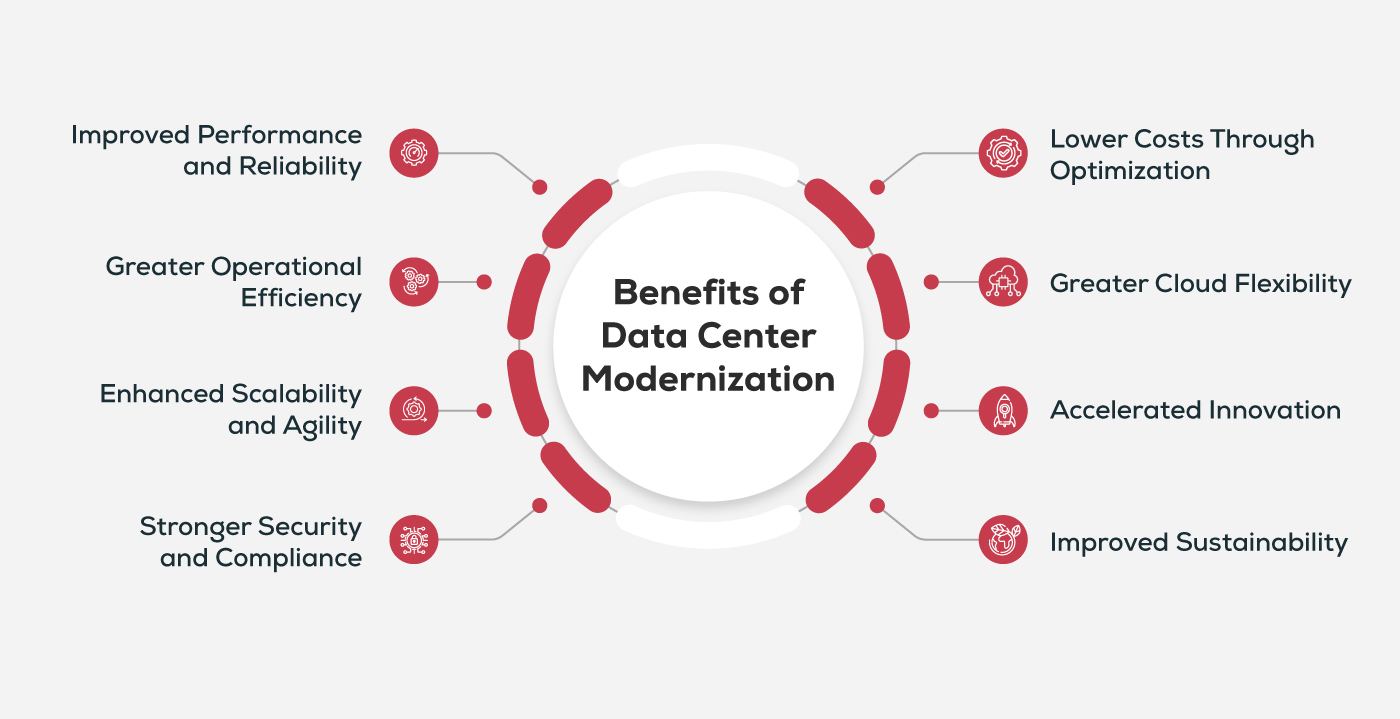
Benefits of Data Center Modernization
The value of data center modernization lies in its ability to align technology with business goals. Here are the key benefits organizations can expect from a modernized IT environment.
1. Improved Performance and Reliability
A modernized data center delivers faster application response times, minimizes service disruptions, and ensures consistent availability of business-critical systems. This enables employees to work more productively while delivering a seamless experience for customers and end users.
2. Greater Operational Efficiency
Modernization simplifies day-to-day IT operations by reducing administrative overhead and streamlining infrastructure management. This allows IT teams to focus on strategic initiatives instead of routine maintenance, improving productivity across the organization.
3. Enhanced Scalability and Agility
Organizations can expand IT resources without significant infrastructure changes as business requirements grow. This flexibility enables faster deployment of new applications, supports expanding operational needs and helps businesses respond quickly to new opportunities.
4. Stronger Security and Compliance
A modernized data center helps strengthen an organization's overall security posture while simplifying compliance with industry and regulatory requirements. This reduces business risk and builds greater confidence in the organization's ability to protect critical systems and data.
5. Lower Costs Through Optimization
Modernization helps organizations maximize the value of their IT investments by reducing maintenance costs, making better use of existing IT resources, and lowering energy consumption. These efficiencies contribute to a lower total cost of ownership while supporting long-term cost optimization.
6. Greater Cloud Flexibility
Organizations gain the flexibility to adopt public cloud services at their own pace and place workloads where they deliver the greatest value. This enables them to maximize cloud computing benefits while aligning deployment decisions with business and operational requirements.
7. Accelerated Innovation
By removing the limitations of legacy infrastructure, organizations can introduce new applications and technologies with greater speed and confidence. This enables data center innovation while helping IT keep pace with changing business priorities.
8. Improved Sustainability
Modernization helps organizations reduce energy consumption by supporting energy efficient data centers and green data centers. This lowers operational costs while contributing to corporate sustainability and environmental goals.
How to Know When Your Data Center Needs Modernization
Not every data center requires immediate modernization. However, recurring operational challenges often indicate that the existing infrastructure is no longer meeting organizational requirements. The following signs suggest it may be time to modernize:
- Frequent performance issues affecting application availability and user experience.
- Aging infrastructure that requires frequent maintenance or a legacy system upgrade.
- Rising operational costs due to inefficient hardware, power consumption and maintenance.
- Limited scalability that restricts capacity expansion or new workload deployment.
- Challenges integrating with cloud platforms or adopting hybrid cloud solutions.
- Increasing security and compliance risks caused by outdated systems and architectures.
- Difficulty supporting emerging technologies such as AI, analytics and edge computing.
Identifying these indicators early helps organizations prioritize modernization initiatives, reduce implementation risks and plan infrastructure investments more effectively.
Take the Next Step in Data Center Modernization
As organizations embrace AI, hybrid cloud and data-intensive applications, modernizing the data center is only the beginning. Sustaining performance, and security requires the right strategy, technology, and operational expertise to keep infrastructure aligned with evolving business needs.
At Inspirisys, our Data Center Managed Services help organizations modernize, manage and optimize their IT infrastructure with confidence. From migration and modernization to 24×7 managed support, we enable resilient, high-performing data centers that are ready for evolving business demands.
Frequently Asked Questions
1. What is the difference between a hardware refresh and data center modernization?
A hardware refresh typically involves replacing outdated equipment to maintain existing operations. Data center modernization takes a broader approach by upgrading infrastructure, optimizing operations, strengthening security, and integrating modern technologies to improve overall performance, scalability, and business readiness.
2. What are the key steps in a data center modernization strategy?
A successful strategy begins with assessing the existing infrastructure and identifying business objectives. Organizations can then prioritize workloads, develop a phased modernization roadmap, implement the required technologies, and continuously monitor and optimize the environment to ensure long-term value.
3. Can data center modernization support public cloud adoption?
Yes. Data center modernization creates an infrastructure that is compatible with public cloud platforms, making it easier to migrate workloads, integrate cloud services, and manage applications across on-premises and cloud environments. This allows organizations to adopt the public cloud at their own pace while maintaining operational flexibility.
3. What are the biggest challenges in data center modernization?
Organizations often face challenges such as integrating legacy systems, minimizing downtime during migration, managing costs, and maintaining security and compliance throughout the process. A well-planned modernization roadmap and an experienced technology partner can help address these challenges while ensuring a smooth transition.